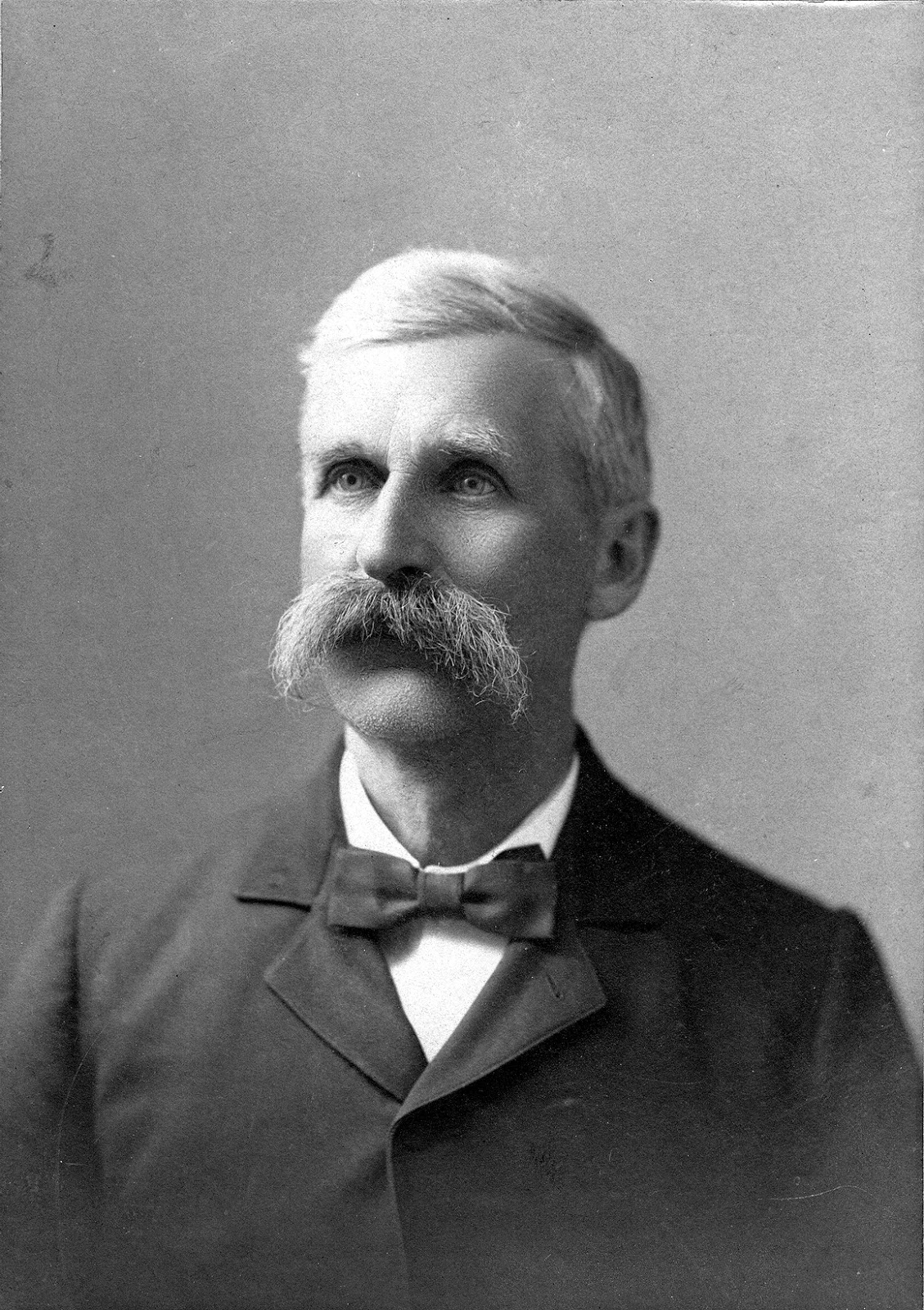
My relationship: Me > Norma Haynes (mother) > Lillian Laffin (mother) > Rosella Hennigar (mother) - my great grandmother
Rose Ellen Hennigar was the 5th of eight children born in Upper Kennetcook, Nova Scotia to John Anthony Hennigar and Letitia Densmore. She went by "Rosella" and was married at age 30 to Asa Laffin (age 27) on July 10, 1890 in Upper Kennetcook.
Asa was a bachelor farmer in nearby Northfield (also known as "Hennigar"). He had inherited his father's farm when he died in 1880. Asa and Rosella made their home and raised their family in Northfield. The farm consisted of 400-500 acres. The family lived in a large wooden frame house (which is no longer standing) consisting of a living room, dining room, parlor, kitchen, pantry, and one bedroom on the main floor with three bedrooms upstairs. Asa grew oats, wheat, barley, and vegetables on the farm and had a small orchard. He also had a dairy herd as well as pigs, sheep, chickens, and horses.
Rosella was described as quiet and peaceful, asking for nothing nor wanting nothing, and a good friend to everyone.
They had 7 children (6 daughters and 1 son):
Minnie Laffin (1891 - 1965), married Alfred Anthony
Nada Laffin (1892 - 1988), married William Turple
Amy Laffin (1894 - 1974), married (1) Alexander McLearn, (2) Harry McCulloch
Lillian Laffin (1895 - 1984), married Thomas Haynes
Ruby Laffin (1898 - 1986), married George Densmore
Adeline Laffin (1901 - 1901), only lived 10 days
Addison Laffin (1903 - 1982), married Evelyn McKeil
There is someone who misses you sadly
And finds the year long since you went
There is someone who thinks of you daily
But tries to be brave and content.
So we shed a tear that is silent
And breathe a sigh of regret
For you were our dear mother and we'll remember
If all the world should forget.
Deep in our hearts you are fondly remembered
Sweet happy memories cling round your name
Fond hearts that loved you with truest affection
Always will love you in death just the same.
God saw that she was weary
The hills were hard to climb
So he closed her weary eyelids
And whispered Peace be Thine.
Wednesday, July 26, 2017
Monday, May 29, 2017
John TUBBS - Memorial Day Tribute
John Tubbs (1752 - 1778)
My relationship: Me > William R. Compton II > Helen Tubbs > Samuel Murray Tubbs > Kelsey Tubbs > John Tubbs > John Tubbs (my 4th great grandfather)
Although I have a number of ancestors who fought in the French-Indian Wars, the Revolutionary War (on both sides), the War of 1812, and the Civil War, most all survived their service. John Tubbs was an exception.
He was born in 1752 in Lyme, Connecticut. He married Sarah Sims, (born 1743 in Lebanon Connecticut) on December 7, 1772. They settled in the Kingston area of the Wyoming Valley of Pennsylvania. They had two children, sons John Tubbs, Jr. and George Tubbs. John is listed as a taxpayer in Kingston in 1776.
During the Revolutionary War, John enlisted on September 19th, 1776 in a call for volunteers in Capt Robert Durkee's company at Wyoming, PA., attached to Col John Durkee's regiment, of the 4th Connecticut line.
Private John Tubbs (one of fifty Pennsylvania riflemen) fought at the Battle Of Millstone on Jan. 20th 1777. He received a bounty for his service at the battle. He was also likely involved in the actions at Bound Brook, at Brandywine, at Germantown, and at Mud Fort and he may have wintered at Valley Forge as the company was present there. It is confirmed that he did winter encamp (1777 -1778) at Morristown, NJ.
The Battle of Wyoming (Pennsylvania) took place on July 3, 1778. [From ExplorePAhistory.com: The Battle of Wyoming and the massacre that followed, in July 1778, has been called the "surpassing horror of the American Revolution" because of the brutal and horrific acts committed by Iroquois Confederation warriors and their British and Loyalist allies against the Connecticut Yankees who had settled Pennsylvania's Wyoming Valley.]
John died on July 3, 1778. There is conflicting information as to whether he died from dysentery contracted while at Morristown, or whether he died in the slaughter at the Battle of Wyoming which was fought on July 3, the same day of his death. John may have been too sick to take part. He may have indeed lingered on long enough to have served or may have been massacred. His brother, Lebbeus Tubbs was in this battle, and survived.
John is buried at Kingston, PA about 4 miles from the site of the Battle.
My relationship: Me > William R. Compton II > Helen Tubbs > Samuel Murray Tubbs > Kelsey Tubbs > John Tubbs > John Tubbs (my 4th great grandfather)
Although I have a number of ancestors who fought in the French-Indian Wars, the Revolutionary War (on both sides), the War of 1812, and the Civil War, most all survived their service. John Tubbs was an exception.
He was born in 1752 in Lyme, Connecticut. He married Sarah Sims, (born 1743 in Lebanon Connecticut) on December 7, 1772. They settled in the Kingston area of the Wyoming Valley of Pennsylvania. They had two children, sons John Tubbs, Jr. and George Tubbs. John is listed as a taxpayer in Kingston in 1776.
During the Revolutionary War, John enlisted on September 19th, 1776 in a call for volunteers in Capt Robert Durkee's company at Wyoming, PA., attached to Col John Durkee's regiment, of the 4th Connecticut line.
Private John Tubbs (one of fifty Pennsylvania riflemen) fought at the Battle Of Millstone on Jan. 20th 1777. He received a bounty for his service at the battle. He was also likely involved in the actions at Bound Brook, at Brandywine, at Germantown, and at Mud Fort and he may have wintered at Valley Forge as the company was present there. It is confirmed that he did winter encamp (1777 -1778) at Morristown, NJ.
The Battle of Wyoming (Pennsylvania) took place on July 3, 1778. [From ExplorePAhistory.com: The Battle of Wyoming and the massacre that followed, in July 1778, has been called the "surpassing horror of the American Revolution" because of the brutal and horrific acts committed by Iroquois Confederation warriors and their British and Loyalist allies against the Connecticut Yankees who had settled Pennsylvania's Wyoming Valley.]
John died on July 3, 1778. There is conflicting information as to whether he died from dysentery contracted while at Morristown, or whether he died in the slaughter at the Battle of Wyoming which was fought on July 3, the same day of his death. John may have been too sick to take part. He may have indeed lingered on long enough to have served or may have been massacred. His brother, Lebbeus Tubbs was in this battle, and survived.
John is buried at Kingston, PA about 4 miles from the site of the Battle.
Saturday, May 13, 2017
Little Compton, Rhode Island Ancestors - No Compton's!
It is interesting to note that a number of ancestors of the Laffin, Hennigar, Densmore lines settled and lived in Little Compton, Rhode Island in the 1600's. There are none of my Compton ancestors who lived there! The origin of the name of Little Compton is not known.
Some of my direct ancestors who lived there were:
1) William Pabodie and Elizabeth Alden (daughter of Mayflower passengers John Alden and Priscilla Mullin.
2) Sarah Pabodie (their daughter) and John Coe
3) Edward Burgess and Elizabeth Coe (their daughter)
4) Sarah Burgess (their daughter) who married Philip Mosher and moved to Nova Scotia.
5) Edward Richmond and Abigail Davis
6) Esther Richmond and Thomas Burgess
7) Nicholas Mosher
8) Abigail Tripp
9) Rebecca Wilcox
There were also some other direct ancestors that lived in Tiverton, Rhode Island, a town adjacent to Little Compton to the north. These include Mosher, Maxson, and Taber ancestors.
According to 17th century land evidence, Little Compton originally belonged to the Sakonnet (variations include Sogkonate, Seconit, Seaconnet, etc.) tribe, who were led by Awashonks, the cousin of Metacomet (commonly known as King Philip). The area was known by the name Sakonnet, which means “the black goose comes.”
The first European settlers in Little Compton were Englishmen from Duxbury, Massachusetts in the Plymouth Colony who sought to expand their land holdings. After first attempting negotiations with Awashonks, they petitioned the Plymouth Colony, which granted them their charter. In a series of lotteries beginning in 1674 and ending in the early 1680s, they divided the land in Little Compton into lots of standardized acreage and began settling there.
In 1682, the town was incorporated by the Plymouth Colony and renamed Little Compton. This is possibly a reference to Little Compton in Warwickshire, England. However, there is no direct evidence to substantiate this relationship. By 1747, Little Compton secured its own royal decree and was annexed to Newport County as a part of Rhode Island along with Tiverton and Bristol.
| Little Compton Common Cemetery |
Elisabeth Pabodie, the eldest daughter of John Alden and Priscilla Mullins of Mayflower fame, is buried in the Little Compton Common cemetery. The stones in this cemetery reflect a style of carving similar to that found both in Newport, R.I. and in Boston during the same time period.
From Wikipedia:
Elisabeth Pabodie (1623–1717), also known as Elisabeth Alden Pabodie or Elisabeth Peabody, was allegedly the first white woman born in New England. She was born Elisabeth Alden in 1623, the first-born child of the Plymouth Colony settlers John Alden and Priscilla Mullins, who were both passengers on the Mayflower in 1620. She married William Pabodie (Peabody), a leader of Duxbury, Massachusetts, on December 26, 1644. All thirteen of their children were born in Duxbury before Elisabeth eventually moved to Little Compton, Rhode Island in the 1680s. She died on May 31, 1717 in Little Compton and was buried in the cemetery on Little Compton Common.
Markers for Elisabeth Alden Pabodie (my 8th great grandmother)
Sunday, May 7, 2017
Norris Matthew Compton (1836 - 1919)
From: "A Biographical Record of Chemung County, New York", 1902, page 53:
Norris M. Compton (son of Peter Compton and Amy Norris) was born in Veteran, NY on April 26, 1836 and pursued his education in Wyoming Seminary at Kingston, Pennsylvania, where he took a general course. He followed the occupation of farming in Veteran, and was also engaged in general merchandise for a number of years, maintaining his residence in Sullivanville. In 1902, he resided in Horseheads and occupied a clerical position in the office of his son (William R. Compton). Norris and his wife Mary (Brigham) gave their children the best home training and such educational privileges as their means would allow, thus fitting them as well as possible for the practical and responsible duties of life. They attended the Methodist Episcopal Church. Norris, in his political views, was an active Republican, staunchly supporting the principles of the party but never seeking office.
Records of his Service in the Civil War:
Norris M. Compton, first class musician, of the 29th Regiment of Pennsylvania Volunteers, enlisted at Elmira, New York on the 21st day of September, 1861 to serve 3 years. He was born in Chemung County in the state of New York, is 26 years of age, 5 feet 6 3/4 inches high, light complexion, light eyes, light hair, and by occupation when enlisted, a musician. During the last 2 months, said soldier has been unfit for duty for 40 days. Station: USA General Hospital, Frederick, Maryland, May 19, 1862. I certify that I have carefully examined the said Norris M. Compton, a musician, and find him incapable of performing the duties of a soldier because of chronic laryngitis. Discharged this 19th day of May, 1862 at Frederick, Maryland.
Signed
Thomas J Dunoth and A. Apish, Surgeons.
Norris M. Compton, age 45, present post office address Sullivanville, New York. For 5 years immediately preceding my enlistment into the service on 21 Sept 1861 I resided in Sullivanville, Chemung, New York. My occupation for those preceding 5 years was that of a musician teaching and leading funerals. Since my discharge from the service on the 19th day of May 1862, I have resided in Sullivanville, New York until I removed in the year of 1874 to Spencer, Tioga County, New York. I removed from that place in 1875 to Sullivanville, New York, then removed in the year of 1876 to Meadville, Crawford, Pennsylvania, where I lived until 1881, when I came back to Sullivanville where I now live. My occupations have been small grocery business and raising small fruits from 1862 to 1874, and then cigar business since then. The disabilities for which I claim this pension arise from chronic laryngitis. This was contracted in February, 1862 on the march from Frederick City, Maryland to Harpers Ferry. When we got to Winchester, Virginia, I was so bad that I was sent from Winchester to the Frederick City hospital, where I was discharged May 19, 1862. I have been unable to follow any occupation since discharge. My throat is in bad shape and an abscess which formed in my throat while in the Army has never healed and discharges every day. I often am I unable to do anything.
![]() |
| Norris Compton (right) and two dairy farm hands |
"Norris M. Compton was the only child of Peter Compton and Amy Norris Compton, who survived infancy. He was spoiled, a great whiner in his old age, and - as far as I could piece together - a dreamer with no business sense. He was dapper in dress, had a fine handlebar mustache, loved fine horses, good cigars, and, I suspect, whiskey - which could be detected on his breath on occasion. At those times, his wife, Mary (Brigham), would show signs of tears, and the tension could be felt. He never went to church.
In his younger years, he did quite well at the family farm in Sullivanville, NY running a good dairy, and raising crops for feed. In midlife, he took a plunge in a dairy farm on a high ridge 1000 feet above Seneca Lake. It was a day's journey by carriage from Horseheads, where he lived during my childhood, and I loved going with him to the Hill Farm. He was always fun on those trips and had a pocketful of hard candies to dispense enroute. The view from the farm was breathtaking.
On the Hill Farm he was a pioneer in the import of Holstein cattle, noted for the quantity if not the quality of their milk. I loved the dairy with its cool, sweet smell, and the shallow pans of milk set out in a dark corner for the cream to rise to the top. This was before the day of pasteurization and separator machines, but grandfather was very fussy about the cleanliness in the cow barn and dairy. The cow's teats were washed before milking. The milkers had to wash their hands every two cows! He employed 12 hands on Hill Farm. He was the first President of the New York State Holstein Breeders Association.
The price of milk went down in the panic of 1907, and soon thereafter he could not meet his mortgage and lost Hill Farm and the old family farm at Sullivanville. He was never the same after that, and after my grandmother's [Mary Brigham] death in 1910, he lived until 1919 - cared for in turn by his three daughters Ida, Edith and Lena, and financed by his prosperous son, William R. Compton [Sr.] of Elmira."
Obituary in the "Chemung Valley Reporter" 27 November 1919:
Norris M. Compton passed away at the home of one of his daughters, Mrs. J. R. Fitzgerald, at Naperville, IL, Saturday, aged 84 years. He had been spending much time with another daughter at Buffalo, Mrs. J. F. Leffler, and went to Naperville a few weeks ago. Always a resident of this county, he was among the well known men of the section. His ancestors, the Norris and Compton families, were among the pioneers of the southern tier, and composed that hardy stock which settled and developed the locality. Mr. Compton was born at Sullivanville and was a son of the late Peter and Amy Compton, the father being a minister. He died many years ago but the mother lived to be nearly 100 years of age and passed away about 10 years ago. She lived with her son in this village for many years. The deceased served in the Civil War as a musician in the 29th Pennsylvania Regiment and was a member of the Baldwin Post. A few years ago he was extensively engaged in farming and was among the first men in the county to introduce full blood Holstein cattle. He was one of the organizers and the first president of the Chemung Valley Holstein Breeder's Association. He was engaged for several years as a clerk in the U. S. Marshall's office in Elmira. Following the death of his wife a few years ago, Mr. Compton had apartments at the Platt House. Deceased was the father of the late William R. Compton, prominent as a Republican political leader in this county and for several years U.S. marshall for this district. He is survived by three daughters - Mrs. J. Fitzgerald of Naperville, IL, at whose home he passed away; Mrs. Lewis H. Lent of Richfield Park, NJ; Mrs. Lena Leffler, wife of Rev. John F. Leffler, pastor of the Normal Park Methodist church at Buffalo.
Subscribe to:
Posts (Atom)