Tuesday, January 12, 2021

Annie Vessie McNeil

 Annie Vessie McNeil (1836-1913)

My relationship: Me > Norma Haynes(mother) > Thomas Haynes(grandfather) > Annie McNeil (my great grandmother)

Annie was the youngest child of Matthew McNeil and Hannah Lutches Blois. She was born in Nine Mile River, Hants County, Nova Scotia on 26 June 1836. When she was almost 2, her mother died. She married Robert Hanes on 4 December 1860 at the age of 24 in Kennetcook in Hants County. Together they had 9 children, all born in Hants County. 


About 4 years after the last child was born, the whole family (except for their first child Ida Hanes who had married Fred Scott and stayed in Hants County) moved to Boston / Roxbury Massachusetts. The family in Boston all changed the spelling of their last name to Haynes from Hanes. They lived at 53 1/2 Kendall Street where Robert was listed as a laborer in the 1881 Boston directory. Robert died in 1883 of dysentery, preceded 2 weeks earlier by the death of their 11 year old daughter, Lucy Alice Haynes, also of dysentery. 

Annie was left with a large family to take care of, with little means of support. She is subsequently listed in several locations in Roxbury and Boston: In 1890 (22 Auburn Street), 1900 (17 Oakland Street), and 1910 (2800 1/2 Washington Street). It appears she rented places and subletted rooms to boarders to earn income. All of her children that left Canada settled in Boston for the remainder of their lives, except for my grandfather, Thomas. He settled and raised his family in Arlington, Virgnia, after marrying Lillian Laffin from Northfield in Hants County.
 
35 Elmore Street

Annie McNeil Haynes died on 13 April 1913 at 35 Elmore Street, Boston, a multifamily residence. Here she lived with her daughter, Lydia and her husband, John Tubman; their daughter Robina Tubman; and Annie's daughter Sarah (Sadie). The cause of death on her death certificate was "acute bronchitis" at the age of 76. She was buried in Forest Hills Cemetery in Jamaica Plain (a Boston suburb), where her husband, Robert was also buried.  I have visited the cemetery and checked their records. There is no headstone at their burial location.

[The story is that at some point the family changed the spelling of their last name to Haynes from Hanes, because they did not like the pronunciation of the name in Nova Scotia as Hines. However, all Boston records of Robert 1880 - 1883 have his name spelled as Hanes. The death record of their daughter Lucy in 1883 is also spelled Hanes. Therefore, it is likely that the name spelling was changed after Robert's death by Annie, as all records of Annie and their children from 1900 on are spelled Haynes].


Monday, September 14, 2020

Phineas Brigham (1815 - 1889)


My relationship: Me > William R. Compton II > William R. Compton I > Mary Brigham > Phineas Brigham (2nd great-grandfather)

Phineas Brigham, son of Timothy and Patty (Damon) Brigham was born in Smithfield, Bradford, PA on 22 Jan 1815. His parents dying early when a mere child, he was placed in the family of William Baldwin, proprietor of the "Old Fountain Inn " near Wellsburg, NY (Chemung Co.), where he lived for several years. He ran away after a severe flogging, returned, and at last set out for the home of his uncle Salmon Brigham in Madison County, NY, working for his food and lodging on the way. Later he moved to Cazenovia, NY where he attended school in 1834 at the Cazenovia Seminary. He intended to prepare for the Methodist ministry, but after a brief experience as an exhorter, he abandoned the idea. 

He met Eliza Johnson, daughter of Ezekiel Johnson and Hannah Sloan of Cherry Valley, and married her there on October 10, 1838 where they lived at least until the early 1850's, with Eliza's mother.  They had five children, but three died young. One is unknown. Two sons, each named William, died young and are buried in the Cherry Valley Cemetery (William Brigham, born 1 June 1841, died 3 June 1842, and William Loomis Brigham, born 14 Feb 1851, died Jan 1853). The other 2 children were Mary Louise Brigham, born 11 Nov 1839 who became Mrs. Norris M. Compton,  and (Dewitt Clinton) Johnson Brigham born 11 Mar 1846, who went on to become the State Librarian of Iowa (1898-1936). In 1857, Phineas is listed as a clerk (insurance) in Elmira, NY, and again in 1860 in Elmira, house on Gray Street. By June, 1860, they had moved to Dix (Watkins), NY where Phineas is listed as a retail shoe merchant and Eliza as a milliner.

Eliza Johnson


On September 6, 1862 Phineas (age 47) enlisted at Palatine, NY as a Private in the Union Army. His son, Johnson Brigham also enlisted, but he was too young (age 16) for combat, and he was transferred to Washington, D.C. where he worked for the Sanitation Dept. during the war. Phineas was mustered into service on October 17, 1862 in the 153rd Infantry Regiment, Company B at Fonda, NY. The next day, the troops left by railroad traveling to New York City, then Philadelphia, then Baltimore, and then Washington, D.C.  A short steamer trip took them to Alexandria where they arrived at their camp on October 24. They encamped there for the next nine months. Alexandria Virginia was a vast depot of military stores. The Brigade was in charge of guard and police duty over these arms. They were often aroused from sleep forming in a line of battle across the different roads into the city remaining under arms until dawn to repel any attack from the Confederate forces, although none ever came. However, many of the men succumbed to disease, including typhoid, pneumonia, measles, and small pox. Phineas succumbed to malarial fever in October-November, 1862. He was treated for five weeks at a private home in Alexandria, and on December 10, 1862 was admitted to the Regimental Hospital in Alexandria. In July, 1863, he transferred to Washington, D.C. and was assigned as an assistant hospital steward at the Soldier's Retreat. In February, 1864, his regiment was ordered to New Orleans, but he was rendered unfit for active duty in the field and he remained in Washington. Due to his illness, Phineas was transferred to Company C of the U.S. Veteran Reserve Corps, 19th Infantry Regiment. On October 1, 1864 he was transferred to the Confederate Prison Camp at Elmira, NY for the remainder of the war, having charge of a hundred confederates there. This camp, in use from June 6, 1864 until autumn 1865, was dubbed "Hellmira" by its inmates. In the months the site was used as a camp, 12,123 Confederate soldiers were incarcerated; of these, 2,963 died during their stay from a combination of malnutrition, prolonged exposure to brutal winter weather and disease directly attributable to the dismal sanitary conditions on Foster's Pond and lack of medical care. The camp's dead were prepared for burial and laid to rest by the sexton at Woodlawn National Cemetery.  At the end of the war, each prisoner was given a loyalty oath and given a train ticket back home; the last prisoner left the camp on September 27, 1865. Phineas was honorably mustered out on July 13, 1865. [For details, see his Civil War pension file #286100]


After the war, he spent two years in Portage County, Ohio and then moved to Watkins, Schuyler, New York in April, 1868. In 1870 he is listed as Assistant Marshall for the town of Watkins, NY and signed all of the census pages for that year. Eliza is not listed there at that time. Financial and health stresses and struggles weighed on the marriage after the war and a formal divorce decree was issued to Eliza in Macon County, Missouri on 7 Nov 1870.


Myra Andrews


On January 6, 1871 he married Myra Andrews and removed to Canton, Pennsylvania living at 46 Center Street. There they had 2 children, Sarah Elizabeth Brigham, born 28 May, 1873, and Anna Brigham, born 10 April, 1875. Phineas died on 20 May, 1889 in Canton and was buried in the Main Street Cemetery there.


Interesting side note: Brigham Young was a 1st cousin once removed of Phineas Brigham (Brigham Young's mother and Phineas's paternal grandmother were sisters.)


Sources:
 "History of the Brigham Family", W.I. Tyler Brigham, Grafton Press, New York, 1907, pp. 450-451
Wilson's Elmira Directory, 1857, 1860 Boyd's Elmira Directory.
US Census records
!53rd New York Regiment Company B Muster Roll Records
Report of the Adjutant General, 153rd Regiment New York, p. 954.
US Civil War Soldier Records and Profiles, online data base, Ancestry.com
"History of the 153rd New York Volunteers", The History of Montgomery and Fulton Counties, NY, 1878, pp. 178-180.
80th Birthday newspaper article of Eliza Johnson Stone, Des Moines, Iowa, 1902.
Obituary of Phineas Brigham, The Canton Independent-Sentinel, May 23, 1889.


Wednesday, April 22, 2020

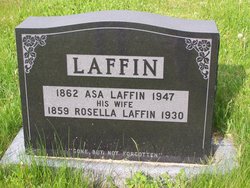
Asa Laffin (1862 - 1947)

 Pedigree: Me > Norma Haynes > Lillian Laffin > Asa Laffin (my great grandfather)  

Asa Laffin was born 5 October 1862 in Northfield, Hants County, Nova Scotia, the last child of (William) Thomas Laffin and Rachel Miller.  He was christened on 1 November 1863.  

   He inherited the family farm when his father passed away in 1880.  The farm consisted of 400-500 acres.  There was originally a log cabin on the property.  Then a large wooden frame house was built with a living room, dining room, parlor, kitchen, pantry, and one bedroom on the main floor and three bedrooms upstairs.  Asa grew oats, wheat, barley, and vegetables on the farm and had a small orchard.  He also had a dairy herd as well as pigs, sheep, chickens, and horses.  He used some hired help to assist him on the farm. A brook separated his farm from the farm of Chester Laffin to the east, and there was a pond on the farm that had lots of snapping turtles. The kids loved to catch frogs in the pond. Asa loved to trout fish and was quite competitive about it. There were some gypsum holes on his property, but the gypsum was never mined, as it was at other sites in Hants County. Ropes were placed around these holes so no one would fall into them. 


   Asa was a hard worker, didn’t drink, and was well liked by all.  His friends called him “Uncle Asey.” When he drove his first car and he had to stop, he pulled back on the steering wheel and said “Whoa”, forgetting that he was not on a horse! When Asa was introduced to someone new, he always had to know their parents (almost everyone in the area was related by family back then). He would say “Who ARE you?" In his later life, he broke his hip and convalesced for a while at his daughter Ruby Densmore’s house with her son, Lyman Densmore.

   Asa married Rose Ellen (Rosella) Hennigar (born 24 September 1859 in Upper Kennetcook) on 10 July 1890 in Upper Kennetcook at the St. Peter’s Anglican Church.  Rosella’s parents were John A. Hennigar and Letitia Densmore.   Asa and Rosella had seven children—six girls and the last child was a son, Addison. Lillian Laffin was the fourth child and daughter born in Northfield on 16 November 1895. 


                                        Asa and Rosella with their children (L to R): Ruby, Nada, Lillian, Amy, Minnie and Addison
     
His granddaughter, June Haynes, saw Asa for the first and only time in 1946 when she was almost 16 years old. She and her parents, Lillian Laffin and Tom Haynes, were brought from the train station to the house by Uncle Addison Laffin and his wife, Evelyn. When they arrived, she remembers him sitting in a rocking chair by a kerosene lamp. He was still living at his home.  Addison, being the only son, moved in and began to live with Asa after Rosella died in 1930. He and Evelyn raised their five sons there. Lillian had not seen her father, Asa, since before June was born. Her last visit had been in 1929 when Norma Haynes was only 4 years old. It was a very teary situation. June describes her grandfather, Asa, as a typical grandfather, sort of wiry, and just a wonderful disposition, a real gentleman.


Summer 1929 at Laffin home: Lillian Laffin Haynes, Rosella Hennigar Laffin, Asa Laffin, and Ruby Laffin.
Grandchildren include: Norman Anthony age 13 (son of Minnie Laffin and Alfred Anthony), Norma Haynes age 4 in straw hat, and Wilfred age 4 and Cham age 2 (sons of Ruby Laffin and George Densmore). Baby not identified.


Asa’s mother, Rachel Miller Laffin, lived with the family until she died in 1909.  They also cared for Rosella’s father for several years after his wife died in 1907.  Asa’s sister, Elmira, married Rupert Miller. After Elmira died in 1888, her son Wilfred Miller was cared for at Asa’s home and grew up there.


Asa and Rosella are both buried in the Northfield cemetery at the Anglican Church.  She died 27 September 1930 in her sleep of a heart condition.  Asa died 24 September 1947 of pneumonia. His request for his final meal was maple syrup and Evelyn mixed up some brown sugar and water for him.


References:
1. Lillian Laffin (Haynes), daughter
2. Douglas Township Records
3. Northfield Cemetery
4. June Haynes (Spencer), granddaughter
5. Lyman Densmore, grandson (mother, Ruby Laffin Densmore)


Thursday, February 6, 2020

Peter Compton (1813-1886)

Relationship: Me > William R. Compton II > William R. Compton I > Norris Compton > Peter Compton (my 2nd great-grandfather)

Peter Compton was born in Tompkins County, New York (17 June 1813), son of Stephen and Anna (Van Sickle) Compton. He married Amy Norris on 30 April 1835. She had been born in Sullivan County, New York in 1819, daughter of Matthew and Julia (Van Duzer) Norris. They had only one child, Norris Matthew Compton, born 26 April 1836 in Sullivanville, NY, a small hamlet in the "town" of Veteran, which is situated on the road northeast of Elmira on the way to Ithaca.

Peter became a circuit preacher for the Methodist-Episcopal Church. He and Amy were early members of the church at Sullivanville, NY. There are a number of references to his ministry:

History of Tioga, Chemung, Tompkins, and Schuyler Counties, New York, 1879: The Methodist Episcopal Church of Tyrone Village - The society or class was formed at the schoolhouse in Tyrone Village, Oct 11, 1828, by Elder Nathan B. Dodson, a presiding elder of the Jersey circuit. Among the original members were…..Peter Compton.
History of Tioga, Chemung, Tompkins, and Schuyler Counties New York, 1879 - The Methodist Church - Veteran, New York: In 1832 a class and church was organized at Sullivanville, and were composed of Dietrich Shaffer, leader, Sarah Shaffer, as are Mallory and wife, and soon after Peter and Amy Compton. A meeting house was erected in 1855, thoroughly repaired in 1877, and on June 27, 1878, was rededicated. There are about 25 members.
Landmarks of Tompkins County, New York by John H. Selkreg, 1894; D. Mason & Co., Publisher, Chapter XVI - Town of Danby:  The South Danby Methodist Church was organized as early as 1830, and was formerly a part of the North Danby charge. The church was built in 1836. The charge was separated from the parent church in 1843. In 1871 the church was extensively repaired. The first pastor was Rev. Peter COMPTON.
A History of South Danby and of the Methodist Episcopal Church, 1873:   1839 - Peter Compton preached one year.
Minutes of the Annual Conferences of the Methodist Episcopal Church - Oneida, NY Conference, August 21, 1844 - Peter Compton listed in the Owego District preaching at Flemingville, NY.
Minutes of the Annual Conferences of the Methodist Episcopal Church - Oneida, NY Conference - July 22, 1846 - Peter Compton is listed as Deacon. Also listed as preacher in the Susquehanna District in Pike, NY
Minutes of the Annual Conferences of the Methodist Episcopal Church - Oneida, NY Conference July 21, 1847 - Peter Compton listed as Deacon.  Also listed as preacher in the Susquehanna District in Pike, NY.
Minutes of the Annual Conferences of the Methodist Episcopal Church - Oneida, NY Conference - July 26, 1848 - Peter Compton listed as Deacon.  Also listed as preacher in the Susquehanna District in Greene, NY.
Minutes and Official Journal of the Thirteenth Session of the Central New York Conference of the Methodist Episcopal Church held at Syracuse, New York October 6 - 13, 1880: Local Preacher's Directory - Sullivanville: Peter Compton.

In 1850, the family is listed in the US Census of Barton, Tioga, NY, consisting of Peter ("Methodist preacher"), Amy, son Norris Compton, and Peter's father, Stephen Compton. Peter is also listed in the 1860 (homeopathy physician), 1870 (minister) and 1880 (farmer) censuses for Veteran, NY, living in Sullivanville,

Events:
On May 5, 1834 he purchased property from Langstaff and Sarah Compton in Veteran, NY. It is suspected that Langstaff was his uncle, being a brother of his father, Stephen.

On March 18, 1855 Peter had a dry goods store in Waverly, NY that went up in flames:
From the Owego Gazette: Great Fire in Waverly: A fire broke out in Waverly, on Sunday morning, March 18th, about half past two o'clock, in the rear of P. Compton's dry goods store, destroying 14 buildings. Loss and insurance reported as follows: ....One block of six stores owned by Mr. Spaulding, loss $5000, insured $3000 in Farmers Union Co. and Livingston Co. [Thomas J. Brooks store occupied this block], ...building owned and occupied by P. Compton as a dry good store, loss $5000, building insured in Dividend Company, Glenn Falls, NY for $1000, contents insured in Phoenix Company $3000....

From "The History of Waverly, New York and Vicinity (1943): On the 18th of March, 1855 the necessity for an organized body of firefighters was made painfully manifest by Waverly's first great fire. It began in Peter Compton's store on the south side of Broad Street and burned eastward to and including Mrs. Gibbon's store and westward almost to the Davis Block destroying in all seventeen stores and dealing a severe blow to the business interests of the village. There was no longer any doubt that a fire company was needed...On May 4 the taxable inhabitants voted to allocate $900 to procure a fire engine, hose, etc., which was subsequently purchased in New York City.


On May 18, 1868, Peter was awarded a U.S. patent for a new beehive design:


In 1869 his home is shown on a map of Sullivanville, NY from Atlas of Chemung Co., New York : from actual surveys / by and under the direction of F. W. Beers ; assisted by Geo. P. Sanford & others, 1869. (Notice a neighbor farmer named W. Randall [William], who may have been close friends with father Peter's son, Norris who took over running Peter's farm in Sullivanville, and may have been the reason Norris named his son William Randall Compton.)


Peter is listed in the 1868-69 Gazetteer and Business Directory for Chemung and Schuyler Counties as a patentee and manufacturer of bee hives, and farmer of 7 acres.

Death 17 November 1886.

Death Certificate:


Headstone in the Van Duzer Cemetery in the Compton plot in Veteran, NY


From the "Northern Christian Advocate" on December 9, 1886: Minutes of the Ithaca district conference convened for its seventh annual session in the Aurora Street Church Ithaca New York Monday evening November 29.  M. Shaw reported the death of Peter Compton, a local preacher at Horseheads. An appropriate memoir was prepared and ordered spread on the conference minutes.

Unfortunately, I have been unable to locate this memoir, any obituary in the local newspapers or any photograph of Peter Compton.

Thursday, March 7, 2019

Mathew McNeil (1795 - ?)

My relationship: Me > Norma Haynes (mother) > Thomas N. Haynes (grandfather) > Annie Vessie McNeil (my great grandmother) > Matthew McNeil (My great great grandfather)

Matthew McNeil was the son of John McNeil (or McNeal) and Elizabeth McLearn (or McLennan).  He was born in the Douglas Township of Hants County, Nova Scotia on 7 November 1795.  He married Hannah Lutches Blois (daughter of early settlers Abraham Blois and Sarah Margaret Kilcup) on 8 December 1823 in Douglas Township.  They had six children: John (1824 - 1885), Lydia Jane (1826 - 1902), Lavina (1829 - 1905), Hugh (1830 - 1910), Twins Olive (1832 -    ) and Oliver (1832 - 1911), and Annie Vessie McNeil (1836 - 1913) who was my great grandmother.

Hannah died at the young age of 32 (when Annie was almost 2 years old) and was buried in the Gore at the Blois family cemetery. After Hannah died in 1838, the family was broken up and Matthew moved away. I presume Annie stayed in Hants County, probably brought up by relatives, as she married Robert Hanes on December 4, 1860 in Kennetcook, Hants County.

Matthew married again (Bertha, born in New Brunswick) and lived the rest of his life in Clements, Annapolis County and Bear River, Digby County, Nova Scotia and was buried there. He had two children with Bertha: Margaret (1859 - 1947) and Willie (1861 -    ). There is no record of Matthew in the 1881 Canada census, or of Bertha or son Willie.

Matthew's occupation was listed as a shoemaker in the 1871 census and in the marriage record of his daughter, Margaret McNeil, who married James Winchester on July 9, 1878 in Hillsburgh, Digby County.

Saturday, February 9, 2019

William R. Compton (1860-1912) - Part 3: The Scrapbook Miracle

Relationship: Me > William Randall Compton II > William Randall Compton I (grandfather)

In 1974 when my father William R. Compton II died, he willed many of his family possessions to my sister, Anne Compton. She joined the LDS Church in 1975 in Birmingham, Alabama. As she and I were the only children in our family, we decided to split up the responsibilities of genealogy research in 1977.  I would take my mother and her information, and Anne would take our father. Among the many items that Anne had was a black scrapbook of newspaper articles about William R. Compton I (our grandfather), who was appointed U.S. Marshal for northern and western New York state by Presidents McKinley and Theodore Roosevelt.  These had been collected and saved by our grandmother, Helen Tubbs Compton, until his death in 1912. Anne had the 82 scrapbook pages laminated and rebound. She also had many photographs of our Compton line ancestors restored, duplicated and sent to me. During her years in Alabama, she did extensive research on the Compton side of the family, resulting in the submission of thousands of family group sheets with more than 52,000 names to the LDS Church. She was featured in an article in “The Church News” on January 1988 about her research despite her many medical problems.

Soon after this article appeared, she was contacted by Lynn and Dixie in Plano, Texas, distributors of herbal products marketed by Sunrider Corporation. Anne left Alabama shortly thereafter and moved in with them and became a Sunrider distributor as well. In 1989, this couple moved to Oregon and Anne decided to move to Desert Hot Springs, California. Dixie and Lynn planned to rent a storage unit in Oregon. As Anne had no place of her own to store her personal possessions, she asked Dixie if she could take her things with her and store them until such time as Anne could get settled and have a place of her own. In addition to the many personal items of Anne’s, most of the memorabilia items of our father and his parents were included, including the scrapbook. Anne stayed in California until early 1992 and then moved to Nebraska for three years before returning to Desert Hot Springs in 1995.

In 1996, Anne had heard from Dixie that they were moving and would no longer need their storage unit (they had transferred the storage items several times to different localities in Oregon over the 7 year interval).  After requesting access, she and a close friend drove to Oregon. Anne told me at the time that she found many of the boxes were missing, and what remained had been crushed with broken items inside. She salvaged what she could, and after returning to Desert Hot Springs, she was able to send me a number of the remaining Compton items, but said all the rest was either lost or destroyed.

Fast forward: 17 years later, on June 12, 2013 Donald Clark, 72, living in Butte Creek Canyon near Centerville, California shot and killed three Sacramento residents at his property. Two teenagers and a mother had stolen a car, driven up to Mr. Clarke’s property, and he shot them with a 12 gauge pump shotgun as they approached his home. He then put them in their vehicle, along with a bicycle, and drove 20 miles further into the mountains, set the car on fire, and then biked back home. During his trial, it was testified that he moved to the property as a caretaker for an owner in southern California about 1998. It had previously been a boy’s ranch over a hundred years ago, but all that was left was a few sheds, one of which Clark lived in with no electricity or running water. He was described as a scavenger and hoarder who would collect and reuse, resell or take apart and recycle items. He was described as having “everything under the sun.”  He was sentenced to prison for life without parole.

After the property was vacated in June, another man, J.S., settled on the property. On August 31, 2013 a vegetation fire on the property burned 80 acres including the buildings and scattered piles of debris. The property owner wanted to sell the property and asked J.S. to leave the property. He and a girlfriend, Tanya, attempted to clean up and salvage what remained, taking it to nearby Chico, California. They couldn’t afford a storage unit, and they decided they would just get rid of it. A girlfriend of Tanya's, L.N., got wind of the situation and after looking through the stuff found some collectible baseball cards and among other things a newspaper scrapbook. L.N. told her, “You can’t get rid of this; this is somebody’s life!” So some of the items were kept and the rest were destroyed. After keeping them for several years, in 2018 L.N. was cleaning her home and decided to do something about the collected items. She went to Ebay and other sites to find out what the cards were worth, and decided to also try and find someone who might be interested in the scrapbook. Doing a Google search for a William R. Compton who died in Elmira New York in 1912, she came across my “Compton - Haynes Ancestral Nuggets” blog website. I had started this blog in 2017 after I took a class at a family history convention in St. George, Utah. The blog had posts and pictures about William R. Compton, my grandfather. As my email contact was listed on the blog, she sent me an email on December 29, 2018, writing “Dear Mr. Compton, I have your grandfather’s scrapbook.  I have been wanting to get this to you.”  She gave me her phone number, and after talking with her and confirming that she did indeed have the missing scrapbook, she mailed it to me. I received the package on January 12, 2019, and upon opening the package I found the scrapbook of newspaper articles in near pristine condition, having survived for over 44 years after my father died, missing from the family for 30 years, 7 changes of hands and a fire.It was like receiving manna from heaven and a true MIRACLE!


                                                                 SAMPLE PAGES


Tuesday, May 15, 2018

Robert Hanes (1831 - 1883)

My relationship: Me > Norma Haynes (mother) > Thomas N. Haynes > Robert Hanes (my great grandfather)


Robert Hanes was born on July 20, 1831 in Douglas Township, Hants County, Nova Scotia. He was one of thirteen children of John Hanes and Christiana Lahey (married at St. Paul's Anglican Church in Rawdon, Hants County on January 5, 1816).
Robert married Annie Vessie McNeil on December 4, 1860 at Kennetcook, Hants County, and had nine children.
Annie Vessie McNeil


In the 1871 Nova Scotia census, Robert and Annie are living in the Shubenacadie district of Hants County. At this time they had six children, all living, and they were living with Robert's parents John and Christiana. Robert is listed as a farmer and lumberman and could not read or write. He was said to be very strong, having at one time lifted a ship's anchor.

Sometime after their last child Lavinia (Millie) was born in 1876, the family moved to Boston. Robert is listed in the Boston City directories in 1880, 1882 and 1883. However, the family is not enumerated in the Boston 1880 census.

In the Massachusetts Death Records it states that Robert Hanes (laborer) died on August 7, 1883 at 53 1/2 Kendall Street, Boston of dysentery. A daughter, Lucy Alice, had died 14 days earlier of dysentery as well at age 11. Robert was buried in the Forest Hills Cemetery in Jamaica Plain. I have visited the cemetery and checked their records. There is no headstone at his burial location.

[The story is that at some point the family changed the spelling of their last name to Haynes, because they did not like the pronunciation of the name in Nova Scotia as Hines. However, all Boston records of Robert 1880 - 1883 have his name spelled as Hanes. The death record of his daughter Lucy in 1883 is also spelled Hanes. Therefore, it is likely that the name spelling was changed after Robert's death by Annie, as all records of Annie and their children from 1900 on are spelled Haynes].


Saturday, January 6, 2018

William Randall Compton (1860 - 1912) - Part 2

Continued........

William R. Compton resigned his position in the Treasury Department after a service of two years and came to Elmira, NY to engage in the real estate business in 1891. Charles F. Hurlburt was interested with him, the firm name being Compton & Hurlburt.


In 1893-94, he built a beautiful home in Elmira at 925 College Avenue, which was even written up in the newspaper:
William R. Compton, the real estate agent, is building one of the handsomest houses now in process of erection about Elmira. The house is half way between this city and Horseheads. The house is designed by a lover of out-door air and has piazzas and balconies of the most spacious dimensions at every possible point. The observatory commands a view of the Chemung Valley as far as the eye can reach, sweeping far over the city to the south and an equal distance over the village of Horseheads to the north. The view stops only where the encircling hills touch the horizon.
The house, by the way, will be equipped with all the modern conveniences. Hot and cold water wherever wanted, electric light in every room and street cars each way every half hour will enable the Compton family to enjoy all the pleasures of both country and city life. The grounds are spacious and in proper time this will be one of the handsomest places about Elmira.


On July 17, 1898 he was appointed for the first time as U.S. Marshal of the northern district of NY by President McKinley. During the first four years, the office was in Rochester, NY and was then moved to Elmira, NY as a result of Mr. Compton’s efforts. Mr. Compton served four consecutive terms as U.S. Marshal. He was appointed by three Presidents: McKinley, Theodore Roosevelt, and Taft. A term of appointment was for four years at a salary of $9000. This was a high salary in those days. They were extremely well off and obtained the first car in the area—this is when motor cars first came out! The U.S. Marshal appointed his own deputies, and William Compton had 17 field deputies under him. Some of the charges in cases he dealt with mentioned in articles included: selling liquor to the Indians (many cases), smuggling Chinese into the country in violation of the Chinese Exclusion Act, misappropriation of bank funds, and counterfeiting.


He wore a mustache and smoked cigars. He was described in one article as an enthusiastic horseman and in another as spending a considerable amount of time in the pursuit of reading.

In 1899 Mr. Compton became an enthusiast on the subject of incubators and would travel miles to see one in operation! This was a new invention there. A newspaper reporter described how Mr. Compton attended a big poultry show and quoted him as he discussed how incubator parties were being given in his area: “Up our way many of the young society folk are giving what they call incubator parties. The host or hostess finds out the time when a lot of chickens are due and they invite their friends to go with them to watch the little fellows break through their brittle covering into the world. They have a great deal of fun at these incubator parties and the merriment at times was high at the antics of the chickens when they first come from the shell.” He became the Treasurer of the E. W. Andrews Incubator Company in Elmira.
He also became President of the LaFrance Jewelry Company of Elmira in 1899.

On February 25, 1899 he divorced his first wife, Alice, and on April 27, 1899 he married Helen Rosamond Tubbs, who at the time was a stenographer and secretary  in his Realty office.
They moved into the beautiful upscale home he had had built in Elmira and had one son (my father), William Randall Compton, Jr., born July 9, 1902.


William R. Compton with his son, William, Jr.
Upon the death of Mr. Hurlburt in 1903, the William R. Compton Realty Company was organized. The office was one of the finest in the city and occupied a part of the ground floor of the Realty building.  The idea to which this concern owed its origin was to provide more homes for the industrial classes of the city.  New districts were opened and houses erected with only a small payment down, thus aiding the occupants to apply rent money toward a home of their own.  The company did a general real estate business, had houses for rent, from the cheapest to the best, acted as agents for property owners, and loans were made on properties.

In December, 1904 Mr. Compton became President and General Manager (he had been a prominent stockholder) of the United States Cut Flower Company. This company was incorporated under the laws of the State of NY in June, 1903 and began doing business in Elmira, NY in March, 1904. This company had one of the largest greenhouses in the world and as of 1908 had 18 long greenhouses constantly in operation and operating at different degrees of temperature. One house was devoted to the culture of the tea rose (many types). Three houses were devoted to the culture of green plants called similax, and the different varieties of asparagus, plumosia, and sperengi. A section measuring 65 ft. by 100 ft. was the home of the lily of the valley, the hyacinth, daffodils, and other spring blooming varieties. The bulb stock ready for shipment was kept here too. A field was used for growing carnations until they reached the proper stage and were brought inside. The field was then used for chrysanthemums. The company could never grow enough hydrangeas and other flowers of that variety to supply the demand. Flowers were packed daily for destinations in NY and as far away as Hot Springs, Arkansas and Denver, Colorado arriving there in good condition.

One of the newspaper political cartoons which appeared in 1908 has these verses:
William R. Compton, the marshal
To Republican methods is partial.
He likes flowers, too, and grows quite a few
While his real estate makes quite a parcel.

Elmira Star Gazette March 18, 1908
The following descriptions are mainly from newspaper articles. A few of the excerpts are from letters of recommendation for the position of US Marshal concerning the character and talents of William Compton. Nearly 100% of the comments praise what an exceptionally talented orator he was. Some excerpts of a few talks are included in the articles:
“. . .easy, graceful talker and whether in humor or pathos, whether in a dress suit at a banquet, somber black at a memorial service or in everyday dress on a bench in a political convention, he always knows just what to say and how to say it.”
“. . .endowed with a high order of executive ability.”
“. . .one of the most genial and warm hearted of men, interested in all matters of common concern in the community and contributing generously of time and money for their advancement.”
“. . .generally wears a silk tie and his friends call him ‘Billy’ when they are intimate enough to presume on that familiarity.”
“. . .His word was as good as gold.”
“. . .sterling qualities of intelligence, industry, and integrity.”
“. . .thoroughly honest.”
“. . .a perfect gentleman at all times.”
“. . .can be relied upon under any and all circumstances.”

He died on April on April 28, 1912, unexpectedly from complications of long-standing diabetes (for which insulin treatments had not yet been discovered). He was buried in the Woodlawn Cemetery in Elmira, where my father is also buried.


Comment: My grandfather was a self-made man with great ambitions and talents who became a leading businessman and politician in the community, whose life was unfortunately cut short at an early age of 52.

Tuesday, November 21, 2017

William Randall Compton (1860 - 1912) - Part 1

Pedigree: Me > William Randall Compton II > William Randall Compton (grandfather)

William Randall Compton was born in Sullivanville, Chemung County, N.Y. on April 8, 1860, the son of Norris Matthew and Mary Brigham Compton. His siblings (my grandaunts and granduncle) were Ida Louis Compton (1857 - 1950), Johnson Brigham Compton (1863 -1886), Edith Mary Compton (1875 - 1964), and Lena May Compton (1879 - 1940).
He attended the common schools in the area until he was ten years old. By that time his services at home had become too valuable to allow his going to school except in the winter.

Compton home in Sullivanville, NY
At thirteen he entered the Spencer Academy at Spencer, Tioga County, N.Y., which he attended two terms.

Spencer Academy
He continued to study by himself, however, after his daily farm work was finished, and became a well-read, cultured man, taking special pride in the collection and possession of a good library.
The family then moved to Meadville, Pennsylvania in 1876, living at 838 Liberty Street until 1880.

838 Liberty Street, Meadville, PA
He attended the Bryant, Stratton & Smith Business College at Meadville. After completing the course there he was made a clerk in the Meadville post office, holding the position two years. 

Meadville Post Office (2nd from left)


He then went west, and worked on a farm in Illinois during the summer of 1880. Returning to the east, he secured a position with United States Express (a package delivery company) at Meadville, but soon gave up this work to engage in the manufacture of cigars, in partnership with his brother, Johnson Brigham Compton, back at Sullivanville in 1881.

On June 8, 1881 he married Alice Forshee (1860 - 1936) in nearby Watkins Glen, N.Y. They had four children (my half-uncles and half-aunts): Amy E. Compton (1882 - 1882 at age 4 1/2 months), Isabel Compton (1884 - 1972), Leon Randall Compton (1885 - 1920), and Fassett Brigham Compton (1889 - 1957), all born at Sullivanville.

William Randall Compton
Alice Forshee


The cigar business at Sullivanville with his brother proved distasteful, and he subsequently became a traveling salesman, continuing this occupation until 1889. At the age of 28 he joined the Masonic fraternity in the Southern Light Lodge No. 725 at Breesport, N. Y. His related dates were:
Initiated August 25, 1888, Passed September 8, 1888, Raised September 22, 1888
Breesville, N.Y. Masonic Lodge
His services to the Republican party in the presidential campaign of 1888, and his high qualifications for the position, led to his appointment, soon after the inauguration of President Harrison, in 1889 as chief clerk in the Office of the Sixth Auditor of the Treasury for the Post-office Department in Washington, D.C.  He resigned this position after a service of two years and came back to Elmira to engage in the real estate business.

To be continued...........